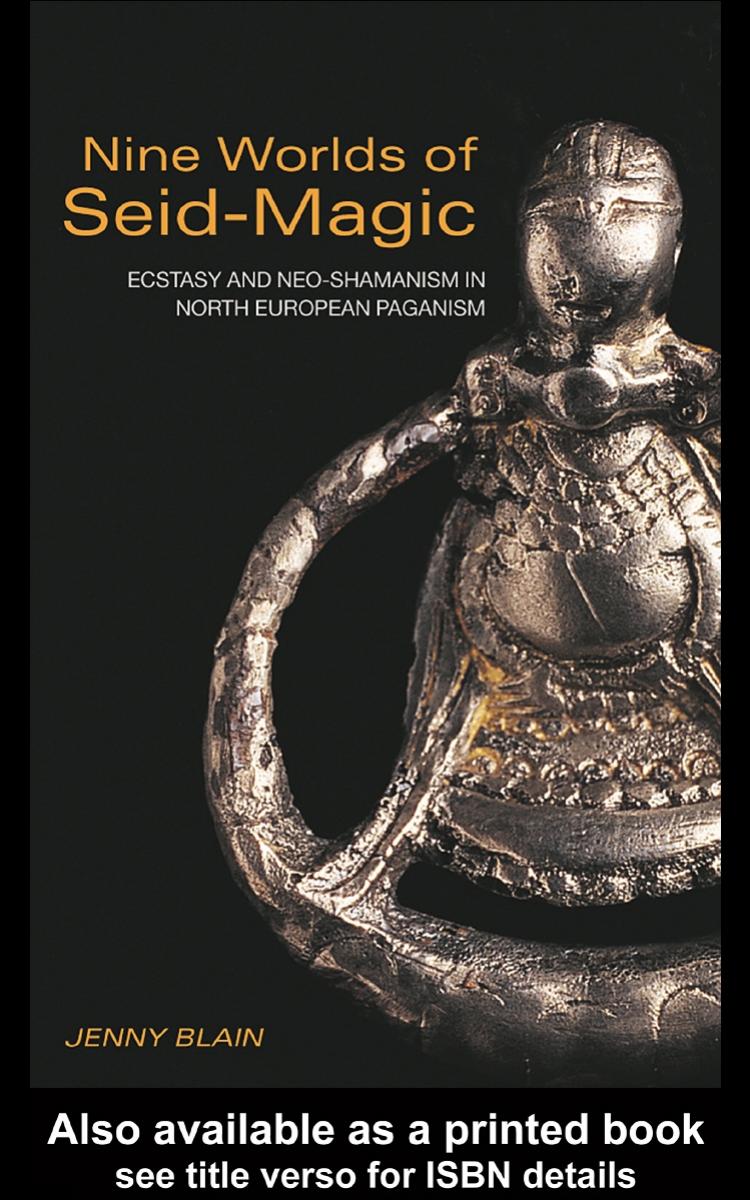
Nine Worlds of Seid-Magic: Ecstasy and Neo-Shamanism in North European Paganism by Blain Jenny
Author:Blain, Jenny [Blain, Jenny]
Language: eng
Format: mobi, pdf
Tags: Humanities
Publisher: Taylor and Francis
Published: 2003-09-01T16:00:00+00:00
chapter 4 I indicated that the accounts could be regarded as pointing to realities for women, part of a cultural framework in which ecstasy, magic and prophesy could occur, in which women could ask spirits to assist them. It is time, now, to enquire further about these women, and how what they did appears to relate to their communities.
I earlier mentioned þórdis. In the Saga of the Water-dalers (Vatnsdæla) the same spákona þórdís uses her power to resolve a dispute in court. 'She had foresight and could see into the future, and therefore was chosen to arbitrate in important cases' (Jones 1973:118): when one party will not accept her judgement, she uses magic to cause them to adopt her peaceful solution.
In Víga-Glúms saga the seeress Oddbjörg is described as 'gleðimaður, fróð og framsýn'; 'a cheerful person, wise and capable of seeing into the future' (Hollander 1972:57). However, it is said of her that she will give good or bad 'spá', foretellings, depending on how she is treated, and when she predicts misfortune for two young boys she is shown the door of their grandmother's house: her prophecy is, of course, borne out by the saga. In Heiðarvíga saga, Ólöf, called Kjannok, is said to be 'vitur mjög ok kunni mart gerla að sjá … fróð og forn í skapi', 'very wise and could see many things clearly … learned and leaning to the old ways'. She charms her foster-son so that he takes no harm from weapons.1 From Gull-þóris saga, there is Heimlaug the völva who dwelt at 'Völva's-steading' in Comb-heath. She gives the leading characters information which may be gained from far-seeing, receiving a gold finger-ring for her knowledge. (Icelandic from Netútgáfan, n.d.).
The later legendary sagas and short stories, which are fiction, told for entertainment value, reintroduce the seeing-women, but now their magic is akin to the 'witchcraft' or spell-craft, supernatural events or powers of later Western fairy-stories, which appears, often seemingly without cause, to create a circumstance which drives the plot, rather than the embedded magic or seeing from within the community. The instances of the 'norns' in the þáttr of Norna-Gest, or the seiðkona Heiðr in Arrow-Odd's saga, given in chapter 4, are examples.
Seeing was not all that the women could do. We have accounts of people shapeshifting, using their abilities to hide themselves or others, causing illusion to be cast. Völsunga saga, the longest of the legendary sagas, holds many instances of magical practice: for instance the mother in law of Signý turns herself to a wolf, by
Download
Nine Worlds of Seid-Magic: Ecstasy and Neo-Shamanism in North European Paganism by Blain Jenny.pdf
This site does not store any files on its server. We only index and link to content provided by other sites. Please contact the content providers to delete copyright contents if any and email us, we'll remove relevant links or contents immediately.
| Paganism | Wicca |
| Witchcraft |
Becoming Supernatural by Dr. Joe Dispenza(8204)
Crystal Healing for Women by Mariah K. Lyons(7928)
The Witchcraft of Salem Village by Shirley Jackson(7257)
Inner Engineering: A Yogi's Guide to Joy by Sadhguru(6785)
The Four Agreements by Don Miguel Ruiz(6746)
The Power of Now: A Guide to Spiritual Enlightenment by Eckhart Tolle(5761)
Secrets of Antigravity Propulsion: Tesla, UFOs, and Classified Aerospace Technology by Ph.D. Paul A. Laviolette(5369)
The Wisdom of Sundays by Oprah Winfrey(5153)
Room 212 by Kate Stewart(5105)
Pale Blue Dot by Carl Sagan(4996)
Fear by Osho(4728)
The David Icke Guide to the Global Conspiracy (and how to end it) by David Icke(4709)
Animal Frequency by Melissa Alvarez(4463)
Rising Strong by Brene Brown(4451)
How to Change Your Mind by Michael Pollan(4355)
Sigil Witchery by Laura Tempest Zakroff(4238)
Man and His Symbols by Carl Gustav Jung(4131)
The Art of Happiness by The Dalai Lama(4125)
Real Magic by Dean Radin PhD(4121)
